01 · Forgiving
Mistakes Are Fixable
Because gouache reactivates with water, you can lift, soften, or completely repaint a passage even after it dries. Beginners get second chances that acrylic never offers.
The gouache paint knowledge base
GouachePaints.com is an independent gouache paint information and review website. Learn what gouache paint is made of, how it compares to watercolor and acrylic, how to choose the best gouache paint set for your budget, and which brands actually deliver — so you can buy once and buy right.
Finish
Matte & velvety
Zero glare — the reason illustrators and designers scan gouache artwork so cleanly.
Opacity
Opaque coverage
Light colors sit over dark ones — unlike transparent watercolor washes.
Binder
Gum arabic, water-based
Cleans up with plain water and reactivates on the palette — nothing is wasted.
Best for
Illustration & plein air
Fast drying, easy layering, portable — a favorite for sketchbooks and studio work alike.
About gouache paint
Gouache paint (pronounced "gwash") is a water-based paint often called opaque watercolor. Like watercolor, it is made from pigment suspended in a gum arabic binder and thins with plain water. What makes gouache different is a higher pigment load, larger pigment particles, and — in many formulas — an inert white filler such as chalk or calcium carbonate. Together these give gouache its two defining traits: strong opacity and a flat, matte finish.
Gouache has a long history. Forms of opaque water media appear in ancient Egyptian works, Persian miniatures, and medieval illuminated manuscripts, and the modern formulation became a staple of 20th-century commercial illustration and design studios — which is why traditional gouache is still sold as "designers gouache." Today it is loved by illustrators, urban sketchers, concept artists, and hobby painters who want bold, even color without the setup of oils or acrylics.
Why choose gouache paint
Every medium has a job it does best. Gouache paint earns its place by combining the convenience of watercolor with the coverage of acrylic — a middle path that suits illustration, design work, sketchbooks, and travel painting exceptionally well.
01 · Forgiving
Because gouache reactivates with water, you can lift, soften, or completely repaint a passage even after it dries. Beginners get second chances that acrylic never offers.
02 · Flat color
Gouache lays down smooth, streak-free blocks of color — the look behind classic poster art, animation backgrounds, and modern editorial illustration.
03 · Light over dark
Add bright highlights on top of dark shapes instead of carefully preserving white paper. You can work dark-to-light or light-to-dark — your choice.
04 · Fast & portable
Water is the only solvent you need. Dried palette paint revives with a spray of water, making gouache ideal for plein air kits and small desks.
05 · Scan-ready
The glare-free matte surface photographs and scans without hot spots, which is why designers and illustrators who digitize their work rely on gouache.
06 · Economical
Paint dried on the palette is not lost — re-wet and keep going. A modest gouache paint set lasts far longer than the same money spent on acrylic.
| Property | Gouache Paint | Watercolor | Acrylic |
|---|---|---|---|
| Opacity | Opaque | Transparent | Opaque to translucent |
| Finish | Matte, velvety | Matte, luminous | Satin to glossy |
| Re-workable after drying | Yes — reactivates with water | Partially | No — dries permanent |
| Light over dark | Yes | No | Yes |
| Drying time | Minutes | Minutes | Minutes, but permanent |
| Cleanup | Water only | Water only | Water before drying; ruins brushes if neglected |
| Best surface | Watercolor paper, illustration board | Watercolor paper | Canvas, wood, paper |
| Ideal for | Illustration, design, sketchbooks, plein air | Loose washes, landscapes | Canvas painting, mixed media |
Buying guide
Gouache paint sets range from a few dollars to well over a hundred, and the label rarely tells the whole story. These seven checkpoints separate the best gouache paint from the disappointing tubes — use them on any brand, at any price.
The heart of good gouache is real pigment, not dye or excessive filler. Test: paint a light color over a dry dark swatch. The best gouache paint covers in one or two coats without turning chalky or streaky. Cheap sets rely on white filler to fake opacity, which deadens color mixes.
If your work will be displayed or sold, check for ASTM lightfastness ratings (I = excellent, II = very good) or the Blue Wool scale (7–8 is best) on the tube or the brand's color chart. Fugitive colors can fade visibly within months in bright light.
Artist grade gouache uses single, named pigments (look for pigment codes like PB29 for ultramarine) at higher concentration — cleaner mixes and stronger tinting. Student grade substitutes cheaper pigment blends and more filler. Beginners can start student grade, but upgrade the colors you use most.
Fresh gouache should be smooth and creamy — like softened butter — with no gritty particles or separated binder pooling in the cap. It should also revive evenly with water after drying on the palette; poorly milled paint re-wets into lumps.
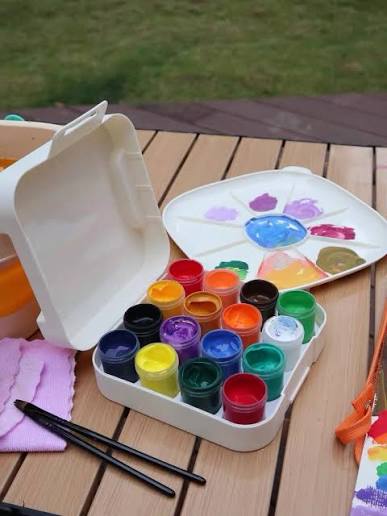
Tubes keep paint fresh longest and suit studio work. Pans and dried-down tube paint travel well. Jelly gouache — large sealed cups popularized by brands like HIMI — offers generous paint for the price and stays moist, making it a favorite first set for students and kids.
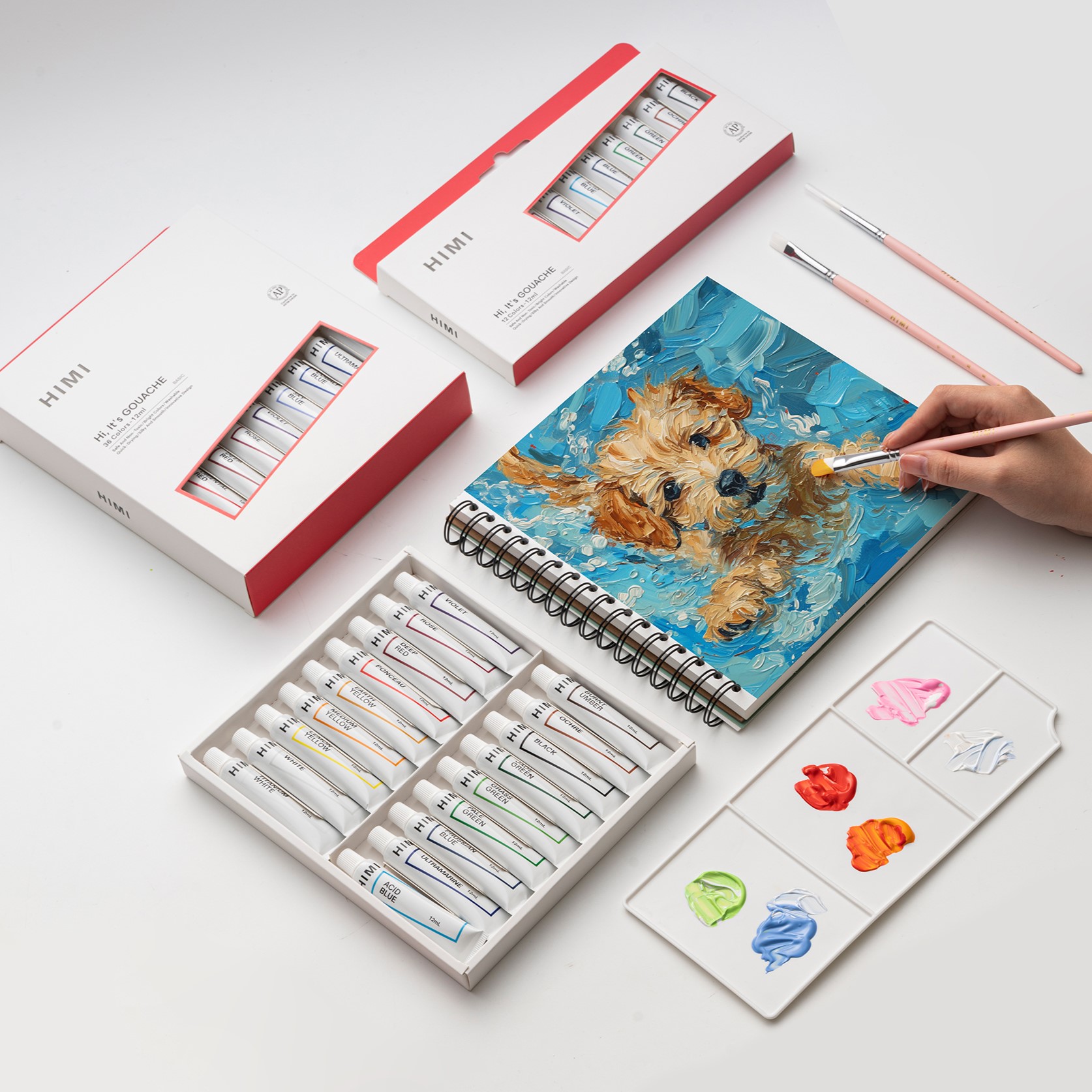
You do not need 56 colors. A strong core is a warm and cool version of each primary, plus titanium white and a deep neutral — roughly 8–12 tubes. Because gouache mixing consumes lots of white, make sure white is available in a larger tube.
Compare sets by total milliliters and pigment quality, not tube count. A 12 × 15 ml artist set often outperforms a 50-color miniature set costing the same, because each tube holds usable amounts of genuinely pigmented paint.
Inside the tube
Understanding what gouache paint is made of tells you exactly why premium tubes behave differently from bargain ones. A tube of gouache contains only a handful of ingredients — but the grade of each one, and how carefully they are milled together, decides everything about how it paints.
Finely ground mineral, synthetic, or organic pigments (e.g., ultramarine PB29, quinacridone PV19, cadmium or azo yellows). Gouache uses coarser, denser pigment loads than watercolor, which is a major source of its opacity.
Natural gum from the acacia tree holds pigment to the paper and keeps the paint water-soluble forever. Premium makers may add dextrin or honey-like humectants to tune flow and slow drying.
An inert white body that boosts coverage and creates the classic matte finish. Balance is everything: a little produces velvet opacity; too much (common in cheap sets) makes mixes chalky and dull.
Glycerin keeps paint from cracking as it dries; wetting agents smooth flow; small amounts of preservative prevent the natural gum binder from spoiling in the tube.
Buyer's shortcut: brands that publish pigment codes, lightfastness ratings, and safety seals on every tube are doing real quality control. Brands that publish none of these usually are not.
Honest reviews
These are the gouache paint brands artists reach for again and again, grouped by who each one actually suits. Ratings reflect pigment quality, opacity, re-wetting behavior, and value for money.
Professional pick
4.9 / 5The long-standing studio standard. Dense pigment, beautifully even matte coverage, and a huge open-stock range with published pigment codes and lightfastness ratings. Priced accordingly, but a little goes far.
Best for: working illustrators & designers
Smoothest handling
4.9 / 5Japanese-made gouache famed for its silky, finely milled consistency and luminous clean mixes. A joy for flat color work and detail. The large color range includes gorgeous muted tones hard to mix yourself.
Best for: detail lovers & color enthusiasts
Natural formula
4.8 / 5Honey-based binder keeps this gouache moist on the palette far longer than most and re-wets beautifully. Very high pigment load with no chalky filler feel. Slower drying — a feature for blenders, a quirk for speed painters.
Best for: plein air & palette economists
Premium heritage
4.8 / 5German-engineered artist gouache with exceptional batch consistency and lightfastness documentation. Slightly satin-matte finish and superb opacity. The choice when archival quality is non-negotiable.
Best for: gallery & commission work
Best value
4.6 / 5A dependable budget tube set with respectable opacity and a wide color selection. Filler content is higher than artist brands, so deep mixes can lighten — but for the price it is an excellent practice workhorse.
Best for: budget-conscious improvers
Beginner favorite
4.5 / 5The viral jelly-cup format: generous 30 ml sealed cups that stay moist for months, cheerful colors, and an unbeatable price per milliliter. Not archival, but the most fun, low-pressure way to start painting with gouache.
Best for: absolute beginners, students & kids
Getting started
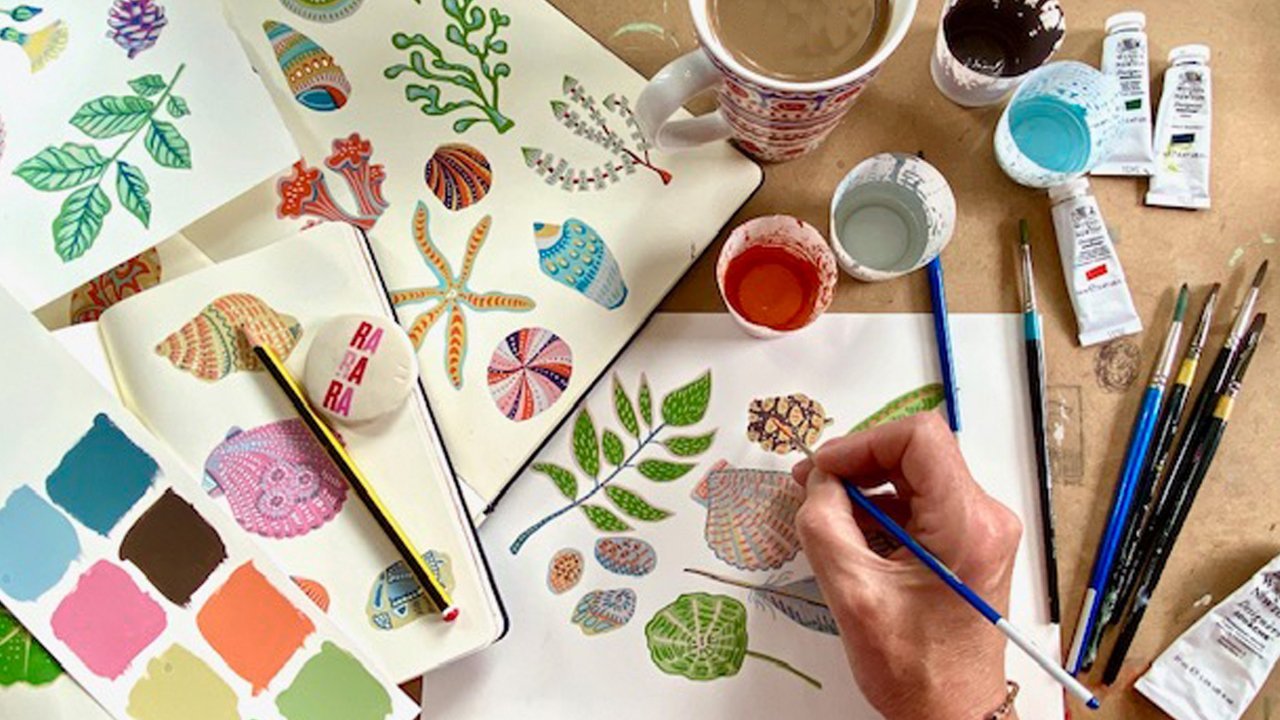
Gouache rewards a simple, confident workflow. Master these five core techniques and you can paint almost anything — from flat editorial illustration to layered plein air landscapes.
Mix paint to the thickness of melted ice cream — thin enough to flow, thick enough to cover. Too much water kills opacity; too little cracks.
Fill the largest color areas flat and even, letting each layer dry before painting the next shape on top.
Use gouache's opacity to add mid-tones, then highlights, on top of dry darker layers. Work quickly with a light touch so lower layers do not reactivate.
Drag nearly dry paint across the paper tooth for grass, wood grain, fur, and sparkle effects.
Save fine lines and brightest accents for last, using a small round brush and paint straight from the tube.
Paper
Cold-press watercolor paper of 200 gsm or heavier, hot-press for smooth detail, illustration board, or toned mixed-media paper — gouache's opacity shines on mid-tone grounds.
Brushes
Soft synthetic rounds and flats handle gouache perfectly. You need only three to start: a large flat for blocking, a medium round for shapes, a small round for detail.
Storage
Cap tubes tightly and store cool. Dried palette wells are fine — mist and reuse. Finished paintings should be framed under glass or sprayed with a fixative, since the surface stays water-sensitive.
Common questions
Quick, straight answers to the questions people ask most before buying their first gouache paint set.
No. Both use pigment in a gum arabic binder and thin with water, but gouache contains more pigment and an opacifying filler, so it is opaque with a matte finish, while watercolor is transparent and relies on the white of the paper for light.
Yes — many teachers consider gouache the most forgiving paint to learn with. Mistakes can be re-wetted and repainted, cleanup needs only water, and opaque layering means you never have to plan around preserving white paper the way watercolor demands.
Jelly gouache comes in large sealed cups with a pudding-like texture that stays moist for months. It is inexpensive, generous, and great fun for beginners, students, and kids. It is not lightfast enough for artwork you plan to sell or display long-term — upgrade to artist tubes for that.
Traditional gouache works best on paper and board; on flexible stretched canvas it can crack because the dried film is not elastic. If you want canvas, use acrylic gouache (acryla gouache), which has an acrylic binder, dries waterproof, and keeps the matte gouache look.
Traditional gouache uses a gum arabic binder and stays water-soluble forever, so layers can reactivate. Acrylic gouache uses an acrylic polymer binder: it dries matte like gouache but becomes permanent and waterproof, so layers never lift — better for clean hard-edge layering, worse for reworking.
Three usual causes: too much water (which breaks opacity into streaks), a low-quality paint with heavy filler, or overworking a layer so it lifts the paint beneath. Aim for a creamy consistency, let layers dry fully, and touch each area as few times as possible.
Sealed tubes typically last five years or more stored cool with caps tight. Even hardened tube paint is usually rescuable — cut the tube open and re-wet it like a pan. Discard paint only if it smells sour (spoiled binder) or refuses to re-mix smoothly.
Most modern gouache is non-toxic under normal use, and student sets carrying the ACMI "AP" seal are certified safe. A few artist-grade pigments (such as genuine cadmiums) carry caution labels — avoid ingesting paint, don't point brushes with your lips, and choose cadmium-free hues for kids.
Six to ten tubes cover almost everything: a warm and cool red, yellow, and blue, plus a large titanium white and optionally burnt sienna and a deep neutral. You will mix richer, more harmonious paintings from a small palette than from a 50-color set.
Because dried gouache remains water-sensitive, the safest protection is framing behind glass, exactly like watercolor. A light archival matte fixative or varnish can add water resistance, but always test on a scrap first — sprays can slightly deepen and unify the matte colors.
You now know what separates the best gouache paint from the rest — pigment load, lightfastness, honest quality control, and the right format for how you paint. Compare current sets and prices in one place.
Shop Now on AmazonOpens in a new tab · As an independent review site, we may earn from qualifying purchases.